
Special Risks Fire Safety Engineering: Petroleum, Flammables, and LPG Installations
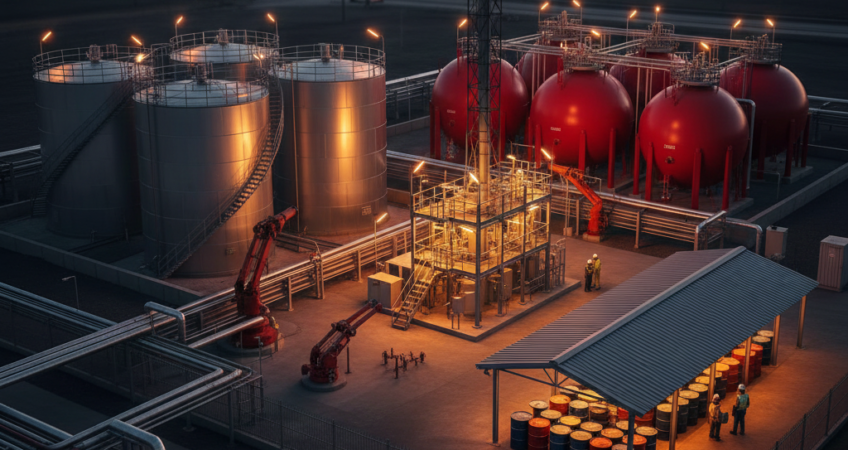
At Songo Engineers, we provide highly specialized fire safety engineering services focused on high-hazard facilities that involve the storage, processing, and handling of Petroleum, Flammable Liquids, and Liquefied Petroleum Gas (LPG). These installations—including tank farms, refineries, chemical plants, loading terminals, and bulk storage facilities—present unique and catastrophic fire risks that demand expertise far exceeding standard building codes.
Our service ensures that your operations achieve the highest levels of safety, compliance, and risk mitigation, safeguarding life, assets, and the environment against large-scale, intensely hot, and rapidly spreading fires.
Key Challenges in Special Risk Environments
The primary hazards in these installations include:
-
Pool Fires: Large, persistent fires involving spilled liquids (e.g., crude oil, gasoline).1
-
Jet Fires: High-velocity flames resulting from the ignition of pressurized gas leaks (e.g., LPG, natural gas).2
-
Flash Fires: Rapid burning of a cloud of diffused flammable vapor without the creation of damaging overpressure.
-
Boiling Liquid Expanding Vapor Explosion (BLEVE): The catastrophic failure of a pressure vessel containing a liquid near its boiling point, often triggered by fire exposure.
Our Special Risks Engineering Services
Our approach is rooted in advanced fire science, risk quantification, and adherence to international standards like NFPA 30 (Flammable and Combustible Liquids Code), NFPA 58 (LPG Code), and API (American Petroleum Institute) recommended practices.
1. Quantitative Risk Assessment (QRA)
We use advanced modeling to quantify potential fire, explosion, and toxic release scenarios. This allows us to predict the consequences of incidents and justify specific safety measures.
-
Consequence Modeling: Predicting heat flux, blast overpressure, and toxic dispersion zones.
-
Fire Scenarios Development: Defining credible worst-case scenarios (e.g., maximum credible spill, simultaneous failures).
2. Fire Suppression System Design (High-Hazard Specific)
We design robust, purpose-built suppression and control systems tailored to the specific fuel and risk.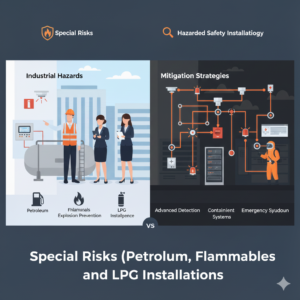
-
Foam Systems: Designing specialized High Expansion Foam and Low Expansion Foam systems for tank protection and dike areas to effectively blanket and smother flammable liquid fires.
-
Deluge/Water Spray Systems: Engineering high-capacity water monitors and fixed spray nozzle systems for rapid cooling of exposed equipment and vessels to prevent pressure buildup and potential BLEVEs.
-
Dry Chemical & Clean Agent Systems: For localized protection of pump stations, control rooms, and electrical cabinets.
3. Passive Fire Protection (PFP) & Separation
We advise on the materials and layouts required to prevent fire spread and protect critical structures.
-
Fireproofing: Specifying and verifying protective coatings on structural steel and pipe racks.
-
Firewalls and Bunds/Dikes: Designing containment barriers (dikes/bunds) around storage tanks to contain spills and specifying fire-rated walls for separation between process areas.
-
Minimum Separation Distances: Ensuring that hazardous equipment and storage facilities are correctly spaced from each other and property lines to minimize heat exposure and cascading failures.
4. Emergency Response and Control
We integrate fire systems with command and control infrastructure.
-
Emergency Shutdown (ESD) Systems: Designing logic for automated and manual shutdown sequences to isolate fuel sources.
-
Fire and Gas Detection Mapping: Optimizing the placement of sophisticated detectors (UV/IR flame, gas/vapor detectors) to ensure rapid identification of leaks and fires.
By partnering with Songo Engineers, you gain the assurance that your high-hazard installation meets the most demanding national and international safety standards, minimizing risk and maximizing operational integrity.
Would you like to know more about the different types of foam concentrates used to suppress hydrocarbon fires?