
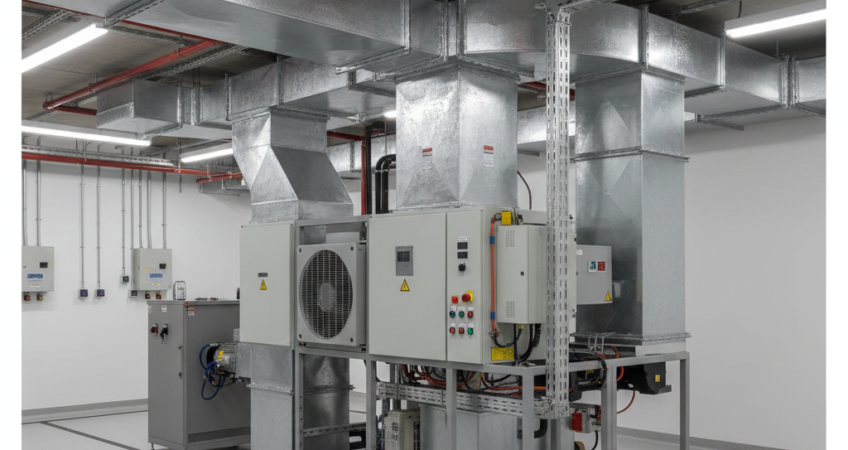
HVAC Mechanical Ventilation: Engineering Healthy and Safe Indoor Air Quality by Songo Engineers
At Songo Engineers, our Mechanical Ventilation service is critical for delivering high-quality Indoor Air Quality (IAQ), managing humidity, controlling odors, and ensuring compliance with stringent health and safety standards. Mechanical ventilation goes beyond simple comfort; it is the engineered process of introducing controlled amounts of fresh outdoor air and exhausting stale, contaminated, or humid indoor air.1
Our expertise is essential for all buildings, especially those with high occupancy, specific contamination risks (like laboratories or kitchens), or high-performance, airtight envelopes.
Why Mechanical Ventilation is Essential
Mechanical ventilation systems are vital because modern, energy-efficient buildings are often sealed, trapping contaminants indoors.2 We engineer systems to address:
- IAQ and Health: Diluting and removing airborne pollutants like Volatile Organic Compounds (VOCs), carbon dioxide (3$CO_2$), dust, and biological contaminants (e.g., viruses and bacteria).4
- Code Compliance: Meeting minimum fresh air requirements mandated by local building codes and standards such as ASHRAE 62.1 (Ventilation for Acceptable Indoor Air Quality).5
- Humidity Control: Removing excess moisture to prevent condensation, mold, and mildew growth, which is critical for building longevity and occupant health.
- Odor and Contaminant Exhaust: Providing dedicated exhaust for areas that generate heavy odors, heat, or dangerous fumes (e.g., kitchens, restrooms, parking garages).
Our Comprehensive Mechanical Ventilation Services
Songo Engineers provides a full lifecycle service for all mechanical ventilation solutions, ensuring systems are effective, efficient, and reliable.
1. Engineered Design and Airflow Analysis
We begin with a detailed analysis of the building’s use and occupancy to design a fit-for-purpose system.
- Air Change Rate Calculation: Determining the required volume of fresh air (in $CFM$ or $L/s$) based on occupancy density, floor area, and specific use of the space.
- Ductwork Sizing and Routing: Designing the supply and exhaust duct networks to ensure uniform air distribution with minimum pressure drop and noise generation.
- Fan Selection: Specifying the correct type and size of supply and exhaust fans to handle the required flow rate and static pressure (e.g., axial flow, centrifugal, plenum fans).6
- Specialized Exhaust: Designing high-performance exhaust systems for specific areas:
- Kitchen Hoods: Grease-rated exhaust systems.
- Laboratories: Fume hood ventilation with safety interlocks.
- Parking Garages: Carbon monoxide ($CO$) monitoring systems linked to variable speed fans.
2. Energy Efficiency Integration (Heat Recovery)
To minimize the energy penalty associated with bringing in fresh air (which needs to be heated or cooled), we specialize in energy-saving solutions:
- Energy Recovery Ventilators (ERVs) / Heat Recovery Ventilators (HRVs): Integrating systems that recover energy from the exhausted stale air stream and transfer it to the incoming fresh air stream, significantly reducing the load on the primary HVAC system.7
3. Installation, Commissioning, and Balancing
- System Balancing: Performing detailed air balancing to measure and adjust air flows at every diffuser and grille, ensuring that the design flow rates are precisely achieved throughout the building.
- Controls Implementation: Integrating the ventilation system with Building Management Systems (BMS), including Demand Control Ventilation (DCV) using $CO_2$ sensors to modulate fan speeds based on real-time occupancy.
By choosing Songo Engineers for your Mechanical Ventilation needs, you are investing in a system that guarantees a healthy, safe, and productive indoor environment while optimizing energy consumption.
Would you like to learn more about the application of Demand Control Ventilation (DCV) in a large office building?